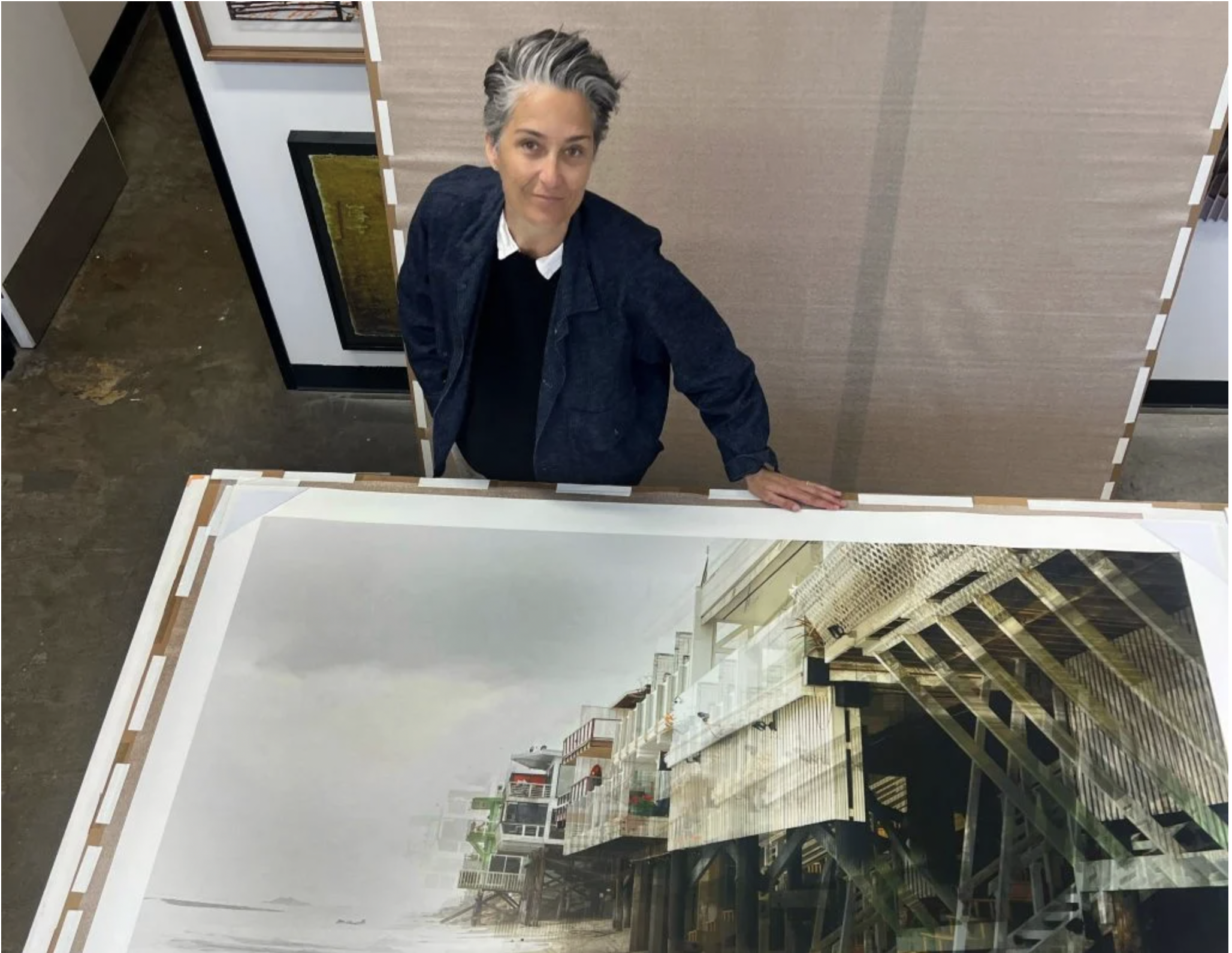
Alex Hedison with the large-format edition of her photograph Untitled #10 (Nowhere), "Everybody Knows This Is Nowhere" (2012). Photo courtesy of the artist.
Sarah Cascone February 20, 2025
For years, artist Alex Hedison had returned again and again to photograph her childhood home in Malibu, mining the sands of the beachfront property for ideas for her work. Though it’s been decades since she lived there, she still experienced a profound sense of loss when she learned the house had burned to the ground in last month’s Palisades Fire.
“It’s a surprisingly strange feeling. I identify so much of who I am, the way I see, and how I am as an artist from place and memory,” Hedison told me. “This is the site of my first conscious memories. As an artist, that’s why I went back to it. I remember these houses with beach pilings that went down into the earth, and sitting down there and looking out at the ocean.”
She’s showing two of her photographs of the home at Frieze Los Angeles this week with Southern Guild, of Cape Town and Los Angeles—a plan that was already in place before the fires. (The photos are both being sold in an edition of three, plus two artist proofs, for $17,000 and $15,000.)
But to say these works are just one photo is somewhat misleading. Hedison digitally combined multiple images shot from the same vantage point over a period of four years to make a single composite. She used different cameras, and worked at different times of the day and year.
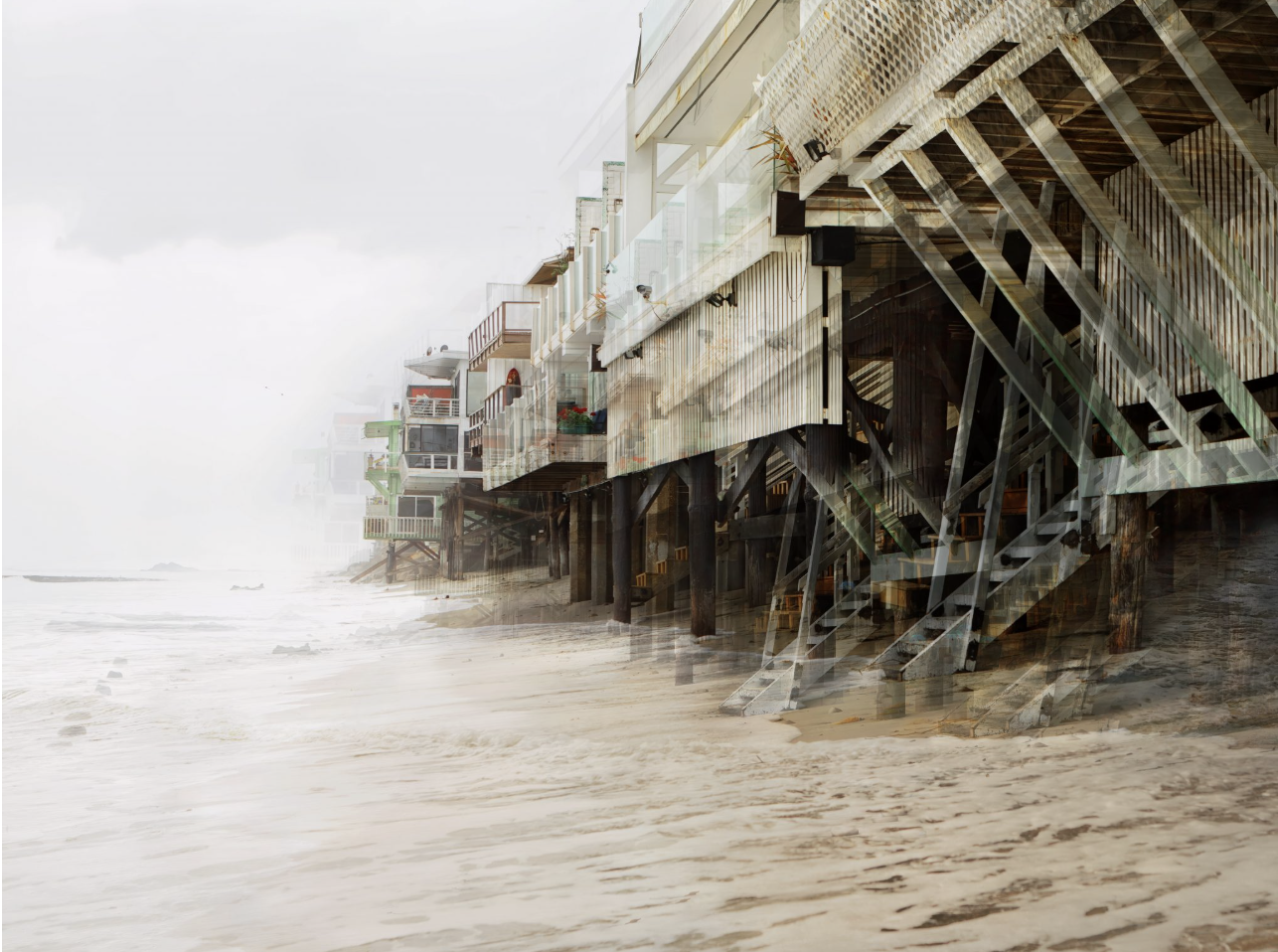
Alex Hedison, Untitled #10 (Nowhere), “Everybody Knows This Is Nowhere” (2012). Photo courtesy of Southern Guild, Los Angeles.
“It’s probably 70 different images made into one,” Hedison explained. “You can see the shifting of time and the sands and wind and the weather. It begs the question, what is reality? What is the truth? What is the memory?”
“Even though it’s very painterly, there are these stark geometric forms which emerge from the bracing of the timber built below the houses, and they overlap,” she added. “It’s a composition with these intersecting diagonals that is archiving the shifts in the beach terrain.”
Now that the building is lost, the effect of the final work is even more unsettling. The different shots don’t line up perfectly, creating a haziness as the many layers hover together.
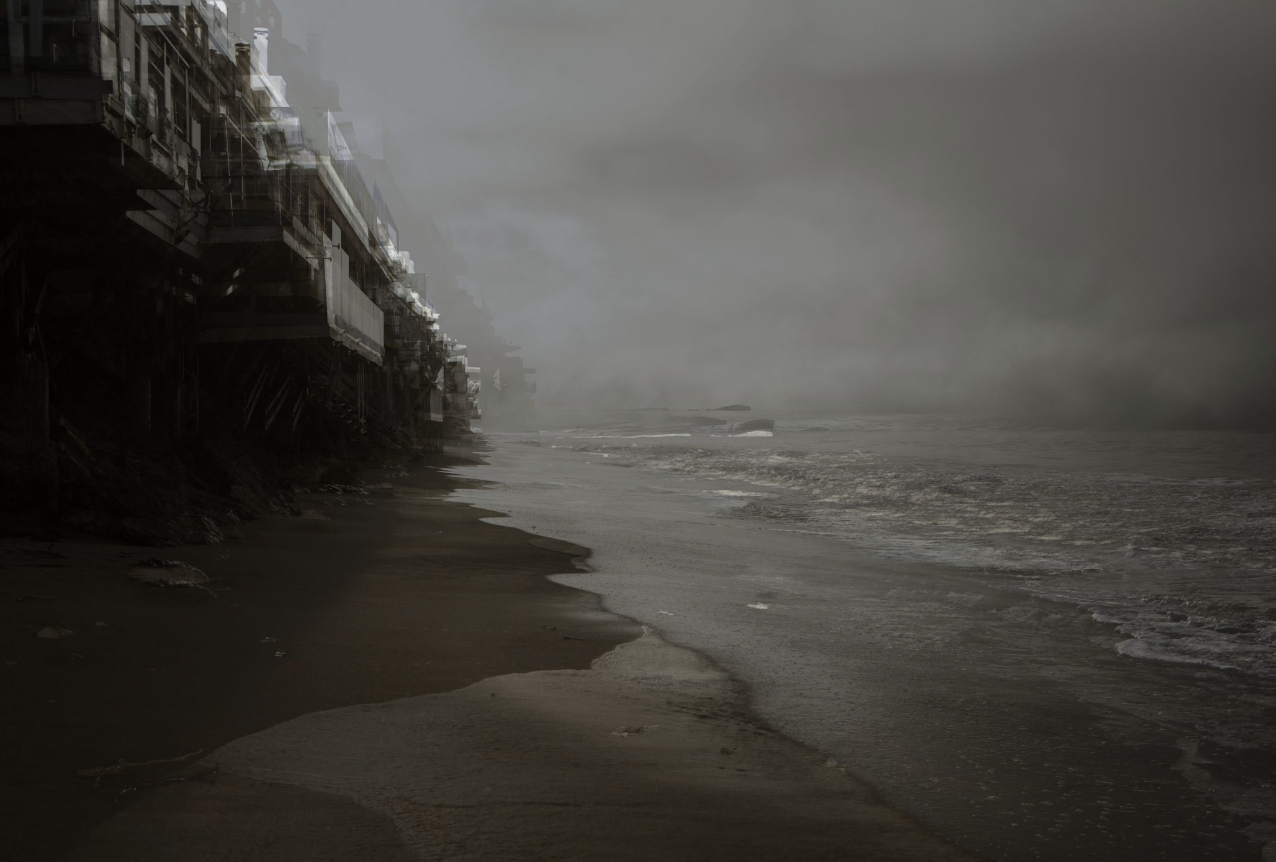
Alex Hedison, Untitled #7 (Nowhere), “Everybody Knows This Is Nowhere” (2012). Photo courtesy of Southern Guild, Los Angeles.
“There’s these ghosts of the house,” Southern Guild founder Trevyn McGowan told me.
The work is from Hedison’s series “Everybody Knows This Is Nowhere” (2008–12), which first debuted in a 2012 solo show at Diane Rosenstein Gallery in Los Angeles. Hedison named the series after the album by Neil Young and Crazy Horse, released in 1969, the year of her birth.
But the title has taken on new resonance now that the entire neighborhood is gone—it really is nowhere, and, in a way, it’s as if Hedison’s work is all that is left.
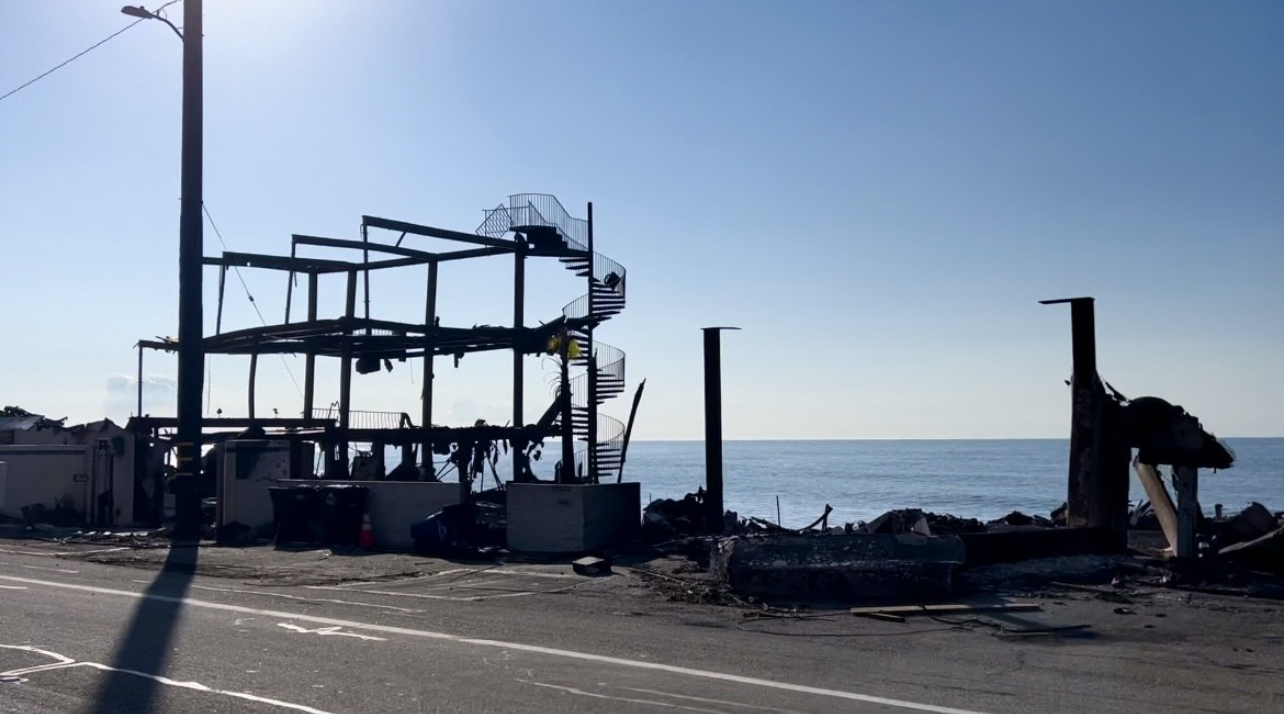
The remains of Alex Hedison’s childhood home in Malibu after the Palisades Fire. Photo by Vincent Walsh.
And though the work documented the evolution of the home where Hedison once lived, the artist was also trying to capture something that had already been lost, a futile attempt to freeze in place her own memories. Now, with the home claimed by fire, Hedison said, “the place that I return to in my mind is now just truly in my mind.”
The day of the Palisades Fire, “the photo was in the process of being printed—it was being birthed in the studio while the fires were removing the actual site,” Hedison added. “It’s the first time I’ve seen it in this size, and it’s breathtaking because the image itself is many, many images shot over time.”
Hedison’s family moved to the Malibu home in 1971 and lived there until 1980.
“It was a very different time then,” she recalled. “There were little tiny houses and artists, and my dad [David Hedison] was an actor. It was just a bunch of hippies who lived there.”
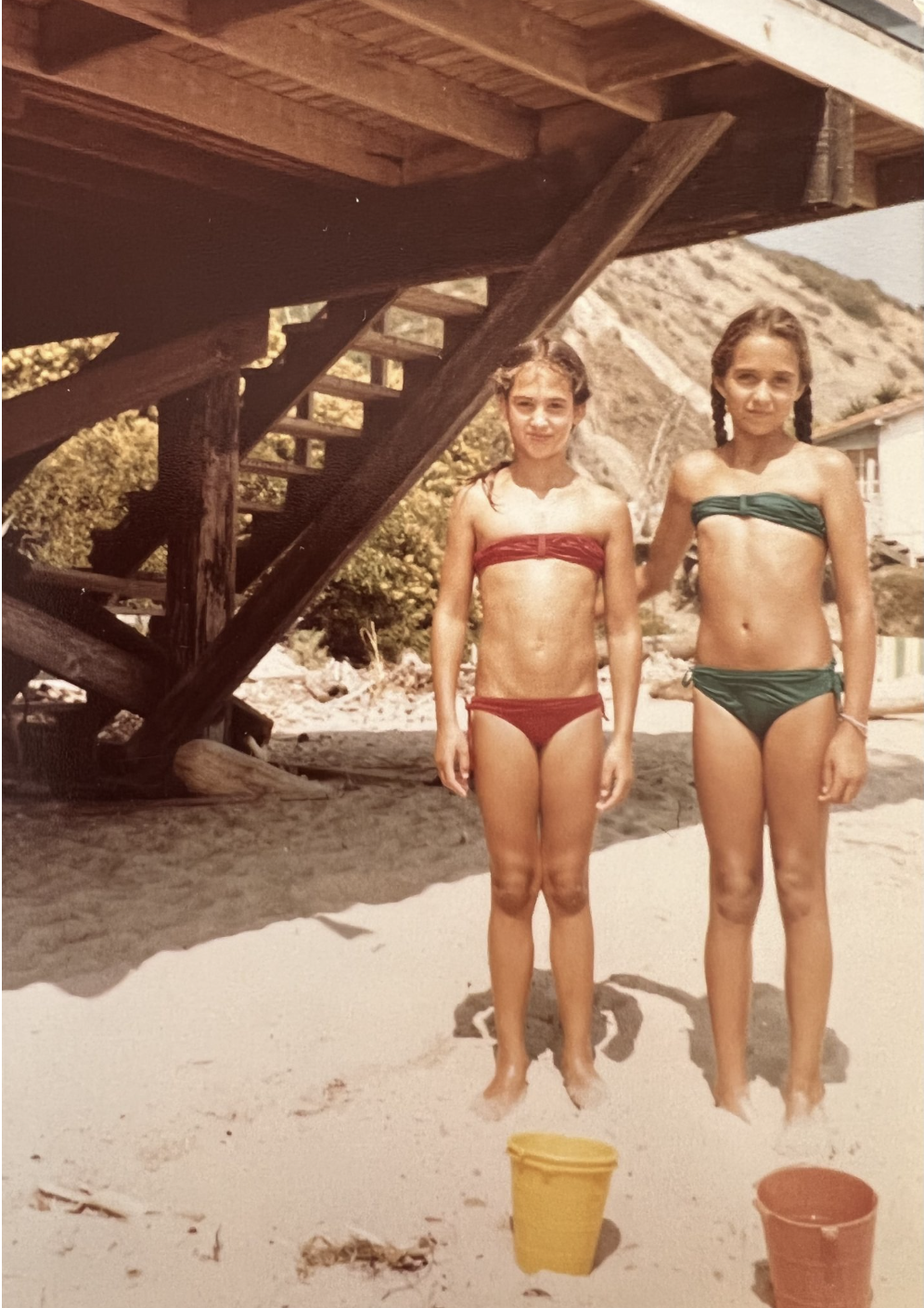
Alex Hedison (right) and her sister Serena at their childhood home in Malibu. Photo courtesy of Alex Hedison.
Hedison would grow up to become an actor herself (and has been married for over a decade to film star and director Jodie Foster), but though she was able to pay the bills in front of the camera, it wasn’t a fulfilling career.
Then, around 1996, someone gave her a camera.
“With the money I was making as an actor, I started experimenting with film and printing and cameras. I was self-taught,” Hedison said. “It took me years before I felt I could even call myself a photographer. I was looking at so many other artists I thought were more legitimate because they’d gone to art school, or they spoke a kind of academic art language that I wasn’t familiar with.”
Her first show came in 2002, at Los Angeles’s Rose Gallery. But shooting “Everybody Knows This Is Nowhere” was part of the way that Hedison came to truly understand her own practice. She started around the time that she officially retired from acting—her last role, on two seasons of The L Word in 2006 and 2009, was probably her most prominent one—drawn back to the shores of Malibu.
Hedison shot in the wind and the rain, on sunny days and on overcast ones, documenting the rising and falling of the tides, the erosion from waves beating the sands, and the transformation of the coastal landscape with the passing of the seasons—and the years.
“These are painterly, abstract compositions that are not finite,” she said. “They’re not stable, and in the instability, in the abstraction, there is a kind of poetry and a beauty.”
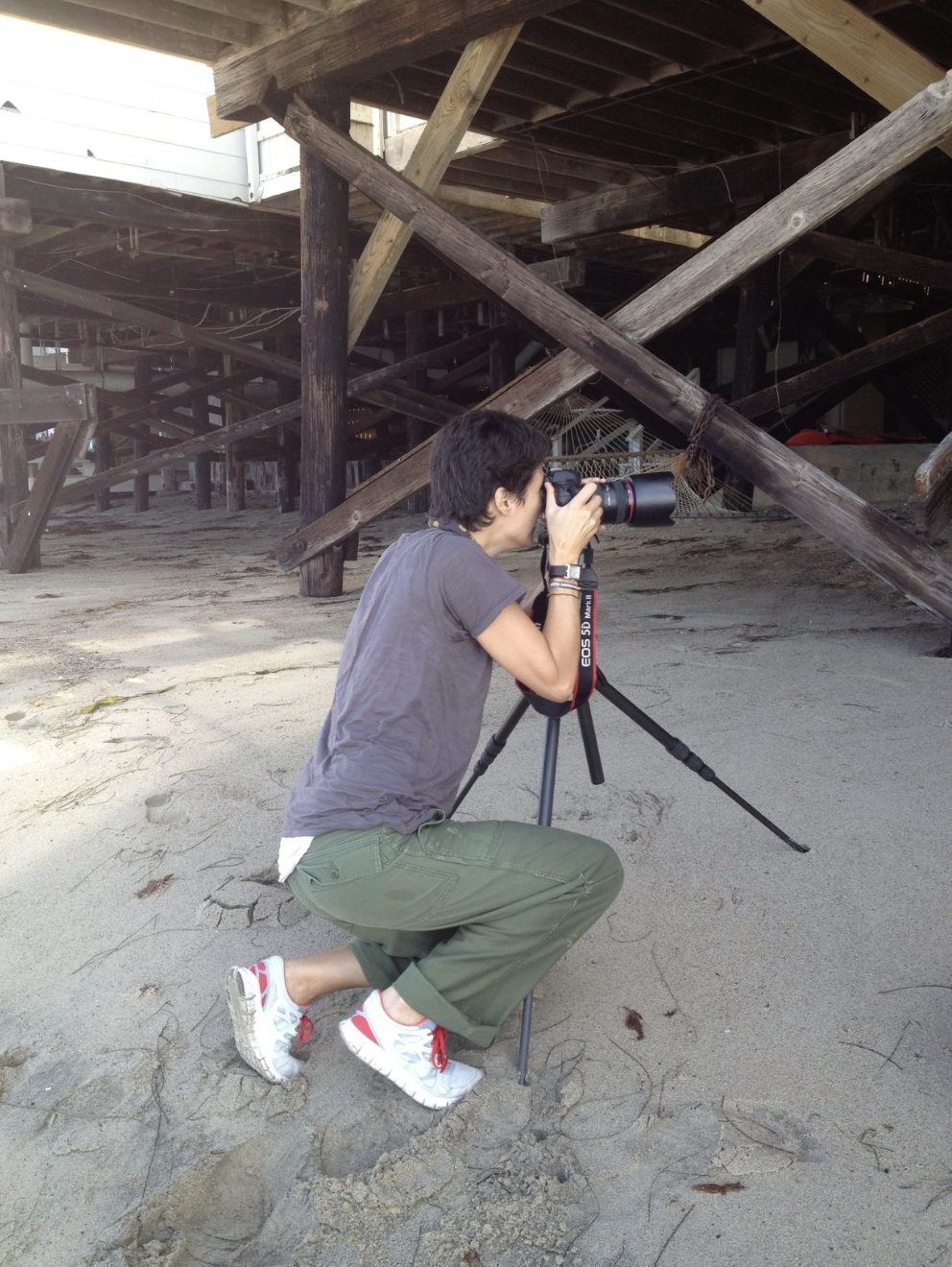
Alex Hedison photographing homes on the shores of Malibu, including the home where she grew up. Photo courtesy of the artist.
It is a project about transition—the physical change of the landscape, but also Hedison ending one professional chapter and beginning another. She was also experimenting with different cameras for the project. She used medium format film cameras, and her father’s 1960s-era manual Nikon, the one her parents had used to photograph her on that very site as a young girl. It was also the first series where Hedison employed a digital camera.
Combining all the photos into one involved many editing choices, “very much the way we do with our own stories, the parts that we highlight, the parts that we obscure and obfuscate,” Hedison said. “It’s the idea of how our stories shift over time.”
“The photograph itself feels like it’s disappearing. And that’s what the whole series is about,” she added. “This whole work is about birth and decay and destruction and death and rebirth all over again.”
The tragedy of Palisades Fire, therefore, is also the start of a new chapter, yet to be written. It will also almost certainly provide new inspiration to the artist.
“I’m desperate to go back. Right now there have been so many rains and mudslides that you just can’t get into the area,” Hedison said. “The second I am able to get there, I will be shooting. I’m pulled to actually physically go there.”
But as climate change–fueled fires and other natural disasters become more and more destructive, Hedison worries that we are “losing our history. These places in time, they literally just exist in our memory.”
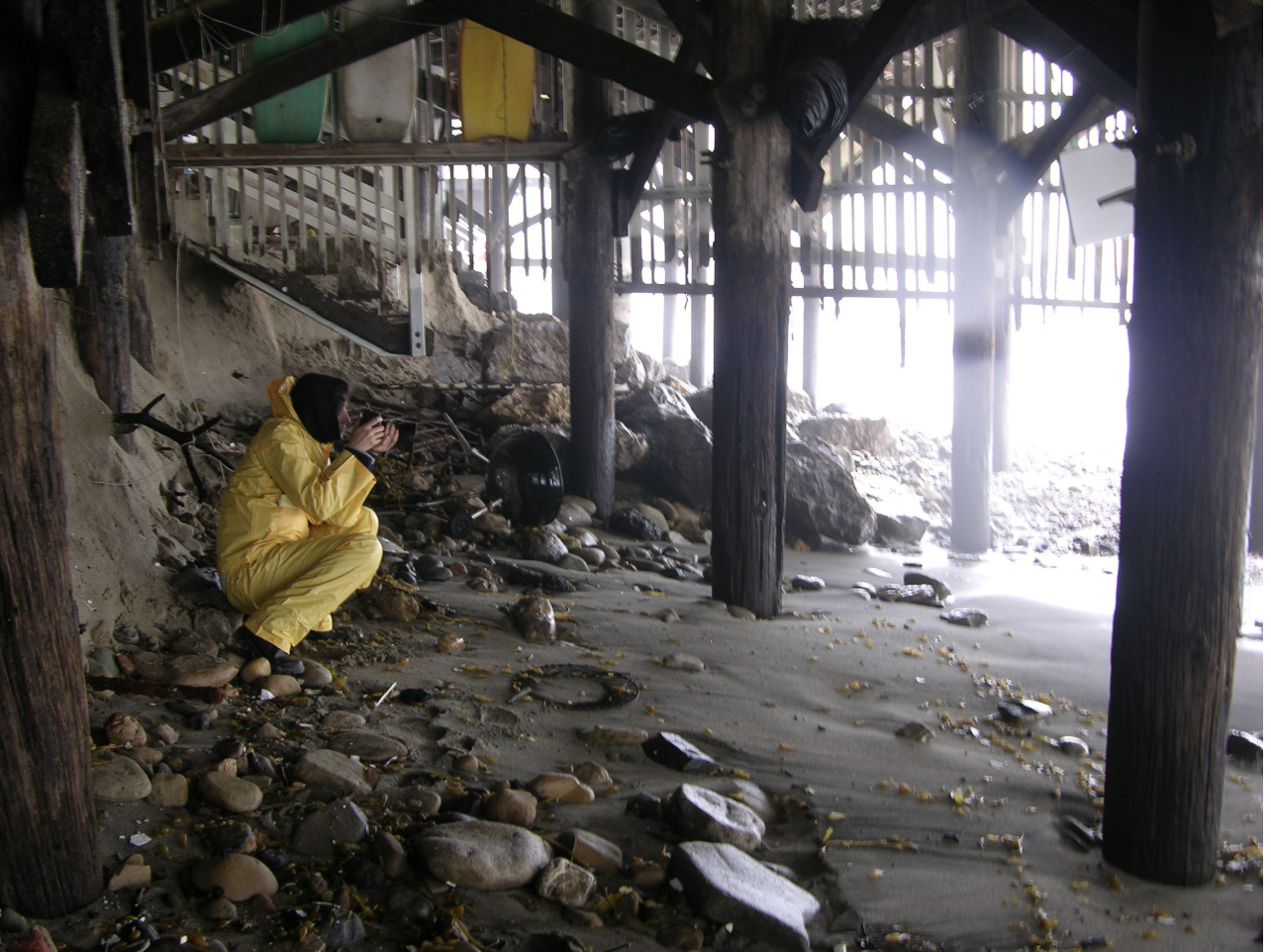
Alex Hedison photographing homes on the shores of Malibu, including the home where she grew up. Photo courtesy of the artist.
In the aftermath of the fires, it is also strangely meaningful for Hedison, a Los Angeles native, to show this work at Frieze. Photos that started out as her own small tribute to the place where she grew up now represent and resonate with the unimaginable loss experienced by so many Angelenos.
“The whole time I was shooting, it felt like these sites were indestructible somehow, even though they were so fragile,” Hedison said. “Susan Sontag describes photography as ‘a funereal testament.’ It celebrates the immutable truth of our mortality. It’s this reminder that everything is temporary.”
She has also donated two of her photographs from the series to “Galleries Together,” a booth at Frieze run by London dealer Victoria Miro that will put its proceeds toward the LA Arts Community Fire Relief Fund, a $12 million effort led by a coalition of local and international cultural institutions.

Alex Hedison, Untitled #3 (Nowhere), “Everybody Knows This Is Nowhere” (2012). Photo courtesy of Southern Guild, Los Angeles.
“It feels really meaningful to show this work specifically at this time, and to help raise money for people who are just at a loss after this disaster. So many artists have lost their their homes, their workspaces,” Hedison said. “I almost see showing this work at Frieze right now as a ritual in some way. And it’s important to have rituals of memoriam.”
“I think sometimes these fairs are so much about the art market versus the art community, but I do feel like we’ve all rallied around each other,” she added. “I feel really proud.”
Frieze Los Angeles is on view at the Santa Monica Airport, Santa Monica, California, February 20–23, 2025.